
How Make-to-Order and Make-to-Stock work—and how SIX ERP blends them for faster delivery, smart customization, and steady profits.
Make-to-Order and Make-to-Stock are not competing ideas. They are planning tools for different customer needs, products, and market conditions.
Manufacturers usually rely on two main ways of planning production: Make-to-Order (MTO) and Make-to-Stock (MTS).
With Make-to-Order, production begins after a confirmed customer order. With Make-to-Stock, products are made in advance and stored until customers buy them.
Neither approach is automatically better. The right choice depends on your product range, demand stability, delivery expectations, available capacity, and the cost of holding inventory. In practice, many successful manufacturers use a hybrid model. They produce common components or semi-finished goods for stock, then complete the final configuration only after receiving the customer order.
This approach can provide both speed and flexibility.
SIX ERP supports MTO, MTS, and hybrid production on one connected platform. It helps sales promise realistic delivery dates, planners balance materials and capacity, purchasing prepare for shortages, and production teams work with clear instructions.
Make-to-Order: Build When the Customer Orders
Make-to-Order means production starts after a real customer order is received.
This model is especially useful when customers need customized products, special sizes, colours, packaging, firmware, labelling, testing, or technical configurations. Instead of producing every possible version in advance, the manufacturer produces exactly what the customer has ordered.
The main advantage is clear: you avoid holding large amounts of finished goods that may not sell. This protects cash flow and reduces the risk of obsolete stock, write-offs, and warehouse congestion.
The trade-off is delivery time. The customer must wait while materials are purchased, machines are scheduled, production is completed, and quality checks are performed.
From Quote to Shipment
A strong MTO process starts with an honest delivery promise.
Before sales confirms a date, SIX ERP can check two important areas:
- Available-to-Promise (ATP): What materials, components, and sub-assemblies are currently available or expected from confirmed inbound orders?
- Capable-to-Promise (CTP): Do you have enough machine time, labour capacity, tooling, and production slots to complete the order on time?
This prevents sales teams from making delivery promises based on optimism rather than real operational data.
Once the order is confirmed, SIX ERP can create the required production flow. It reads the Bill of Materials, follows the routing, creates work orders, and identifies missing materials that need to be purchased.
For configurable products, approved variant rules can automatically select the correct components, operations, test instructions, and labels. This reduces engineering effort and lowers the risk of production errors.
Capacity Must Be Realistic
In MTO production, capacity cannot be treated as unlimited.
The production schedule must consider:
- Machine availability.
- Shift calendars and labour availability.
- Setup and changeover times.
- Planned maintenance windows.
- Tooling restrictions.
- Outsourced operations.
- Existing work orders and customer priorities.
If a machine is fully booked, SIX ERP can move the work to the next available slot, suggest an alternative resource, or highlight the effect on the delivery promise.
A realistic schedule is better than a fast promise that cannot be kept.
Traceability, Quality, and Actual Cost
MTO is especially strong when traceability matters.
Materials can be reserved for a specific customer order so they are not accidentally used elsewhere. Operators can receive digital work instructions, drawings, quality specifications, and test limits directly at the workstation.
As work progresses, the team records completed quantities, actual time, scrap, rework, and quality results. If a critical measurement falls outside tolerance, the process can be paused and reviewed before defective parts reach the next production step.
SIX ERP can also track actual job costs, including:
- Material consumption.
- Labour time.
- Machine time.
- Subcontracting cost.
- Scrap and rework.
- Supplier price changes.
- Extra setup or handling time.
This gives management a clear view of the actual margin per order—not only an average product cost.
A Simple MTO Example
A customer orders 120 custom pumps with a special seal.
The seal has a supplier lead time of five days. Assembly setup takes one day. The line can produce 60 pumps per day. Final testing and packing require one additional day.
SIX ERP checks materials and capacity, then proposes a realistic delivery date:
- Five days to receive the seals.
- One day for setup.
- Two days for assembly.
- One day for testing and packing.
If the seal is a recurring bottleneck, the company could hold a controlled safety stock of seals. This would reduce lead time without forcing the business to hold finished custom pumps in stock.
This is the strength of MTO: low finished-goods risk, clear traceability, and better control over customized production.
Make-to-Stock: Produce Before Orders Arrive
Make-to-Stock means products are produced in advance based on expected demand.
The goal is fast delivery. When a customer places an order, the item is already available in the warehouse and can often ship the same day or the next day.
MTS works best for products with stable or predictable demand, repeat customer orders, standard specifications, and markets where fast delivery is a major competitive advantage.
The benefit is speed. The risk is inventory.
If demand is lower than expected, the business may hold too much stock. If demand rises unexpectedly, the warehouse may run out and customers may turn to competitors.
Forecasting and Inventory Targets
A good MTS process starts with a demand forecast.
SIX ERP can use sales history, seasonality, customer patterns, promotions, known contracts, and planned market activity to create a rolling demand outlook. The forecast should be reviewed often because no forecast remains correct forever.
Once the forecast is available, the company sets inventory targets. Common controls include:
- Minimum stock: A basic protection level against normal demand changes.
- Reorder Point (ROP): The point at which the system should trigger replenishment before stock runs out.
- Maximum stock: A limit that prevents excessive inventory and unnecessary cash tied up in the warehouse.
Some companies may also use buffer zones, such as green, amber, and red, to simplify planning signals.
Production Planning for MTS
SIX ERP can convert inventory targets and forecasts into suggested production orders.
The planner can review recommended batch sizes, production dates, required materials, and capacity. The schedule can be levelled across days and shifts to avoid sudden peaks, idle periods, unnecessary overtime, and inefficient changeovers.
If demand rises, the system can suggest producing earlier. If demand slows, it can recommend delaying or reducing batches to avoid excess stock.
The objective is not to fill the warehouse. The objective is to keep the right stock available at the right time.
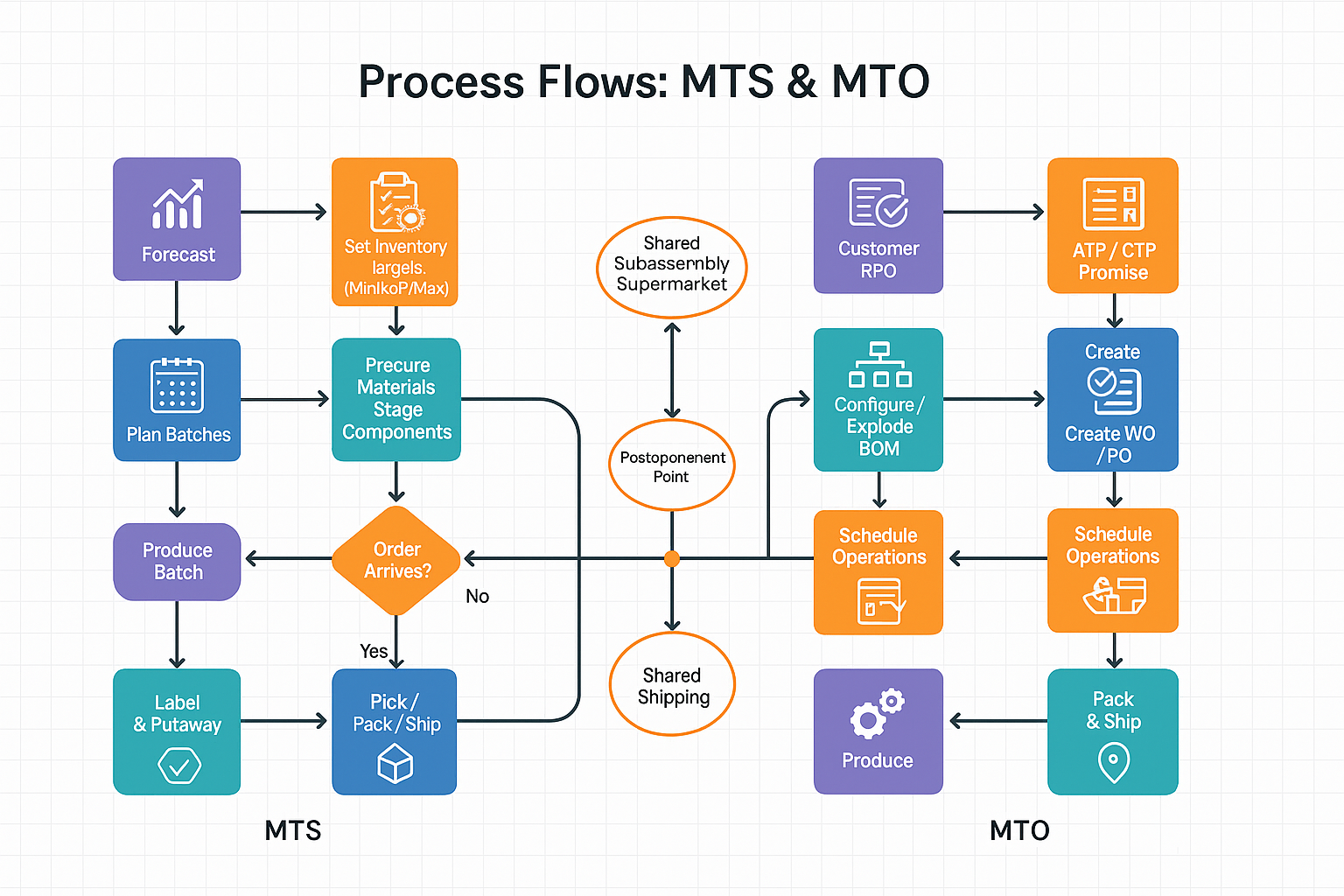
A Simple MTS Example
A manufacturer sells a standard water filter. Average demand is around 100 units per week, with occasional peaks of 130 units.
The company sets:
- Target stock: 300 units.
- Reorder Point: 180 units.
- Standard batch size: 300 units.
On Monday morning, 240 filters are available. A customer orders 120 units, which are shipped the same day. Stock drops to 120 units—below the Reorder Point.
SIX ERP immediately creates a replenishment proposal for the next available production slot. The production team starts the batch on Tuesday and completes it on Wednesday.
The customer receives fast service, production runs efficiently, and stock returns to a safe level.
Key MTS Controls
Because MTS ties up money in inventory, it needs clear controls.
SIX ERP can help monitor:
- Service level or fill rate: How often customers receive products directly from stock.
- Forecast accuracy: How close planned demand was to actual demand.
- Inventory turns: How often stock is sold and replaced.
- Days of Inventory on Hand: How long current stock would last at the present sales rate.
- Slow-moving and obsolete inventory: Products that are not moving as expected.
- Supplier delivery performance: Whether critical materials are arriving on time and in full.
MTS wins when delivery speed matters and demand is stable enough to support smart inventory planning.
Hybrid Production: Combining MTO and MTS
Most manufacturers do not live in a purely MTO or purely MTS world.
Some products need to be available quickly. Others need customer-specific configuration. Many businesses therefore use a hybrid model, where common components are produced for stock and the final version is completed after the customer order arrives.
This is often called postponement.
The Decoupling Point
The most important decision in a hybrid model is the decoupling point.
This is the point where production changes from forecast-driven work to customer-order-driven work.
Before the decoupling point, the company produces common components based on expected demand. After it, the company completes customer-specific work only after receiving an order.
For example, a company may keep the following in stock:
- Common housings.
- Standard motors.
- Printed circuit boards.
- Frames, casings, or base kits.
- Standard accessories.
After the order arrives, the company completes:
- Firmware configuration.
- Customer-specific assembly.
- Labelling.
- Packaging.
- Final testing.
- Certificates and documentation.
This gives customers shorter lead times without forcing the company to stock every possible final variant.
Hybrid Example: Configurable Controller
Imagine a controller sold in many versions. The printed circuit board, housing, and standard accessories are the same for all versions.
The company produces these shared components for stock. When a customer orders a specific variant, the team loads the correct firmware, performs final testing, prints the required label, and ships the unit.
The result is clear:
- Customers receive a faster delivery.
- The company avoids holding stock in rare or slow-moving variants.
- Production can use efficient batches for common components.
- The final configuration remains flexible.
Switching Between Policies
Market conditions change. A product that once had stable demand may become unpredictable. A custom product may become a regular high-volume item after winning a contract.
SIX ERP allows businesses to set an item’s planning policy as:
- Make-to-Order.
- Make-to-Stock.
- Hybrid.
The decoupling point can be set at finished-product level, sub-assembly level, or component level.
A product can move from MTS to MTO when demand becomes unstable, helping reduce write-offs and excess stock. It can move from MTO to MTS when demand becomes regular and fast delivery becomes more important.
These changes can be controlled through approvals and audit trails, so planners, sales teams, purchasing, and finance all understand what changed and why.
How SIX ERP Supports MTO, MTS, and Hybrid Production
SIX ERP helps manufacturers run all three models in one connected system.
For each item, the business can define the planning policy, Bill of Materials, routing, lead times, capacity requirements, quality checks, costing rules, and inventory controls.
For MTO products, the system links sales orders to work orders and material requirements. It checks ATP and CTP before confirming realistic delivery dates.
For MTS products, the system uses forecasts, stock levels, Reorder Points, buffers, batch sizes, and capacity calendars to recommend replenishment.
For hybrid products, it manages shared sub-assemblies as stock items while connecting final production steps to the customer order.
Each department receives the information it needs:
- Sales sees realistic promise dates.
- Planning sees demand, buffers, capacity, and production priorities.
- Purchasing sees critical materials, supplier performance, and approved alternatives.
- Production sees work orders, drawings, instructions, and priorities.
- Quality sees required checks, test limits, traceability records, and certificates.
- Finance sees Work-in-Process, inventory value, actual costs, and variance reasons.
Everyone works from the same operational truth.
Measuring Success
A planning model should prove its value through clear business results.
SIX ERP can help management monitor the measures that matter most:
- On-Time-In-Full (OTIF): Are orders shipped on the promised date and in the correct quantity?
- Service level or fill rate: How often can stocked products ship directly from inventory?
- Forecast accuracy: How closely does expected demand match actual demand?
- Inventory turns and Days of Inventory on Hand: Is cash moving efficiently, or sitting on the shelf?
- Plan and schedule adherence: Did production make what was planned, when it was planned?
- First-Pass Yield: How many products pass quality checks without rework?
- Scrap and rework: Where are time, materials, and margin being lost?
- Cost variance: Why did actual costs differ from planned costs?
These metrics help companies make better decisions. They show when to raise a Reorder Point, reduce a batch size, add a safety stock for a critical component, review a supplier, or move a product from MTS to MTO.
A Safe Rollout Approach
The best way to implement MTO, MTS, or hybrid planning is to start with a focused pilot.
Choose one product family. Classify items as MTO, MTS, or Hybrid. Clean the most important master data: Bills of Materials, routings, work centers, supplier lead times, inventory settings, and quality requirements.
For MTS products, define stock targets and replenishment rules. For MTO products, confirm that material availability, capacity calendars, and lead times are realistic.
Run the pilot for four to eight weeks. Let sales use the promise dates. Let planning review suggested orders. Let production report actual time, quantities, scrap, and completions. Review the results every week.
If stockouts occur, adjust the Reorder Point or reduce replenishment time. If MTO jobs are delayed by one long-lead component, consider holding a small safety stock for that specific part. Change one factor at a time and measure the result.
Small, controlled improvements create long-term planning discipline.
A 12–18 Month Roadmap for Hybrid MTO/MTS
Months 1–3: Discovery and Design
- Map end-to-end processes from sales order to shipment.
- Classify items as MTO, MTS, or Hybrid.
- Define decoupling points for shared sub-assemblies and customer-specific finishing.
- Clean Bills of Materials, routings, work centers, supplier data, and lead times.
- Define KPIs, approval processes, audit requirements, and training needs.
Months 3–6: Core Platform Setup
- Configure Minimum, Reorder Point, Maximum, buffer zones, lot sizing, and planning calendars.
- Set up ATP and CTP checks for realistic delivery promises.
- Configure costing, quality checkpoints, traceability, serialisation, and barcode processes.
- Connect finance, inventory, purchasing, and production data.
- Prepare migration, test scenarios, and user roles.
Months 6–9: Pilot Product Family
- Migrate the required master data.
- Train sales, planning, purchasing, production, quality, and finance teams.
- Run live orders through the selected product family.
- Measure OTIF, fill rate, forecast accuracy, schedule adherence, and First-Pass Yield.
- Improve supplier alternates, safety stocks, setup data, and routing assumptions.
Months 9–12: Scale to More Product Families
- Add two or three further product groups.
- Improve dual sourcing and supplier lead-time controls.
- Refine scheduling, changeovers, and capacity planning.
- Expand dashboards and introduce weekly operational reviews.
- Add machine, warehouse, or sensor data where it brings real value.
Months 12–15: Enterprise Rollout
- Extend the model to further sites, warehouses, or product families.
- Standardize work instructions, labels, tests, and certificates.
- Review inventory targets by product importance and demand behaviour.
- Strengthen security roles, approval policies, backups, and recovery procedures.
Months 15–18: Stabilisation and Optimisation
- Compare results with the original baseline.
- Reduce obsolete and excess stock.
- Improve service level and delivery reliability.
- Introduce advanced demand sensing and variance analysis.
- Establish a regular rhythm for weekly execution reviews, monthly planning reviews, and quarterly policy updates.
Glossary
Make-to-Order (MTO)
Production begins after a confirmed customer order. Best for customized, expensive, or variable products.
Make-to-Stock (MTS)
Production happens before customer orders, based on demand forecasts. Best for standard products with predictable demand.
Bill of Materials (BOM)
The structured list of components, materials, and sub-assemblies needed to make a product.
Routing
The ordered sequence of manufacturing operations, machines, setup times, and work instructions.
Available-to-Promise (ATP)
A check of available stock and confirmed incoming supply to support a realistic delivery date.
Capable-to-Promise (CTP)
A check of material availability, machine capacity, labour, changeovers, and lead times for order-driven production.
Work Order (WO)
The production instruction that tells the factory what to make, how much to make, how to make it, and by when.
Purchase Order (PO)
The formal document sent to a supplier to purchase materials, services, or components.
Decoupling Point
The point where production changes from forecast-driven MTS work to order-driven MTO work.
Minimum / Reorder Point / Maximum
Inventory rules that define the lowest safe level, the point to replenish, and the highest acceptable stock level.
On-Time-In-Full (OTIF)
The percentage of orders shipped on the promised date and in the complete quantity.
Service Level / Fill Rate
The percentage of customer orders that can be delivered directly from available stock.
Forecast Accuracy
A measure of how close predicted demand was to actual demand.
Inventory Turns / Days of Inventory on Hand
Measures that show how quickly stock moves and how long it will last.
First-Pass Yield (FPY)
The percentage of products that pass quality checks the first time, without rework.
Work-in-Process (WIP)
The value of materials and products that have started production but are not yet finished.
Postponement
A hybrid approach where common components are made for stock, while final configuration happens after the customer order.
Choose the Right Model—and Keep It Flexible
MTO is ideal when customization, traceability, and low finished-goods inventory matter most.
MTS is ideal when demand is stable and fast delivery wins business.
Hybrid planning is ideal when you need both fast delivery and controlled customization.
With SIX ERP, manufacturers can manage all three approaches in one connected system. You can define rules per item, plan materials and capacity realistically, protect delivery promises, reduce unnecessary inventory, and make changes when the market moves.
Start with one product family. Measure the results. Improve the rules. Then scale with confidence.
The outcome is not only better planning. It is faster delivery, lower waste, stronger margins, and a manufacturing operation that can adapt without losing control.
If you are reviewing how MTO, MTS, or hybrid planning could work in your factory, book a free 30-minute consultation with the SIX ERP team.